02 / Museum Accessibility / Visitor Experience
ROM Accessibility Evaluation
A course-based accessibility audit examining how visitors find, understand and use access features at the Royal Ontario Museum, with a proposed five-part action plan.
Access across the visitor journey
The evaluation identified a distinction between having accessibility features and making those features visible, understandable and consistent throughout a visit. Tactile objects and inclusive facilities were recorded as strengths, alongside barriers in wayfinding, interpretation and interaction instructions.
The resulting assignment combines a critical experience review, a ten-criterion audit record and five proposed actions for phased implementation over twelve months. It does not document implementation or a subsequent evaluation of the recommendations.
Course context & dates
Prepared for Assignment 2: Museum Accessibility Audit and Action Plan in MSL2306, Special Topics in Museum Studies — Museum and Accessibility: Inclusive Museum Programming, at the University of Toronto Faculty of Information.
The report is dated 8 June 2026 and lists Xinxin Li as its author. It is presented here as a course-based evaluation, not a commissioned ROM assessment or an institutional accessibility certification. The project took place in June 2026; the exact site-visit date is not specified.
Scope of the review
- Arrival and front-of-house access: visibility of assistance, route guidance and access information.
- Movement through galleries: circulation, transitions between areas, interpretive sequence and potential backtracking.
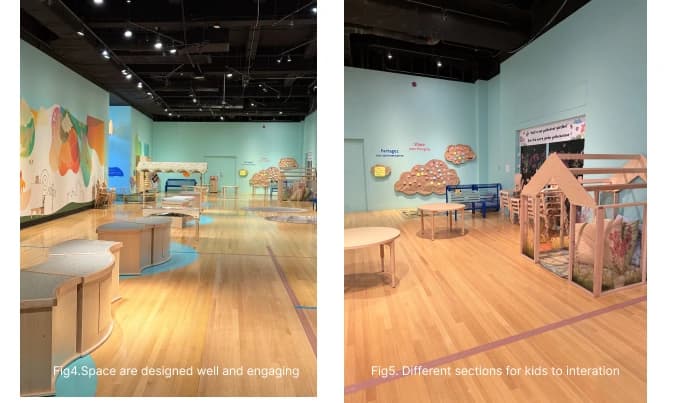
- Sensory and communication conditions: lighting, crowding, label readability, interaction instructions and touch/no-touch cues, including examples from BEES.
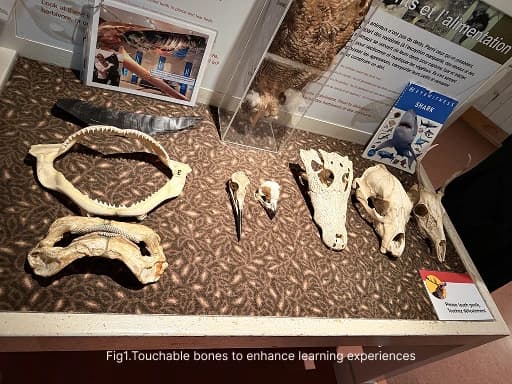
- Existing supports: touchable bones, specimens, textiles, tactile models, Braille and all-gender washrooms, as described in the report.
- Pre-visit access was explicitly marked “Not Observed.” The audit did not assess whether visitors could plan accessible routes through the website or visitor materials.
Method & evaluation criteria
The documented method is a site-visit experience review supported by photographs, qualitative observations and a structured audit tool. The tool groups criteria under physical, sensory, communication, cognitive and pre-visit access, and records a rating, visit evidence and possible visitor implications for each criterion.
Ratings are qualitative judgments: Strong, Partial (Needs Improvement), Needs Improvement and Not Observed. The report references universal design, universal design for learning and a crip-time perspective that considers slower, non-linear and rest-based movement. It does not document numerical thresholds or a formal standards-compliance test.
In the record below, observations describe what the author recorded. Visitor implications describe the author’s interpretation of possible effects; they are not measured outcomes or participant testimony.
Audit record
| Criterion / dimension | Rating | Recorded observation | Potential visitor implication |
|---|---|---|---|
| Circulation / Physical | Partial (Needs Improvement) | Some BEES areas felt narrow and could become congested at high visitor volume. | Could restrict movement for mobility-device users and families, and increase sensory load. Widths were not reported. |
| All-gender washroom / Physical | Strong | The author described the washroom as clear, inclusive and well supplied. | Could support caregivers, families, gender inclusion and comfort. The appendix does not contain a corresponding washroom photograph. |
| Lighting / Sensory | Needs Improvement | Some low-light BEES areas felt dark enough to raise concerns about safe movement. | Possible difficulty for low-vision visitors, children and older adults; no lighting measurements or incidents were documented. |
| Crowding and stimulation / Sensory | Needs Improvement | Narrow paths and immersive lighting were identified as potential difficulties during busy periods. | Could overwhelm sensory-sensitive visitors. Busy-period responses were not measured. |
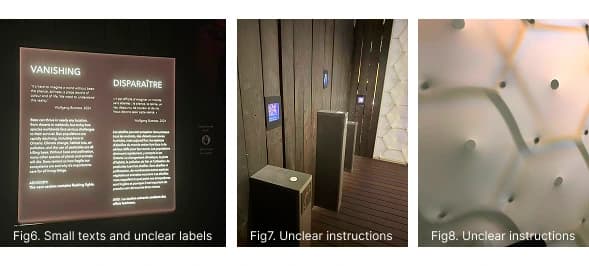
| Label readability / Communication | Needs Improvement | Some labels had small text that required standing close; figure 6 records an example. | Could make reading harder at seated height, with low vision or when other visitors occupy the viewing space. |
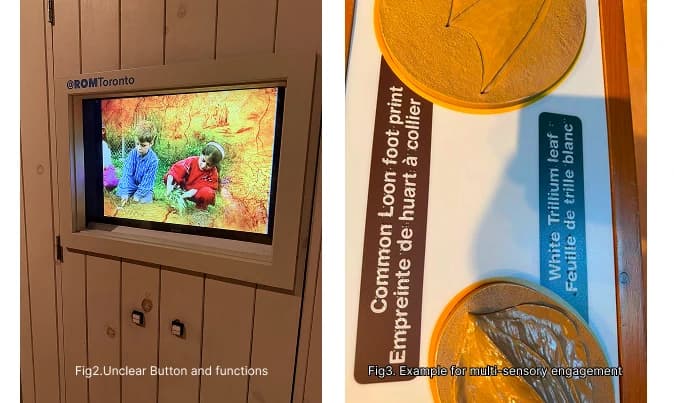
| Interactive instructions / Communication | Needs Improvement | Some platforms offered buttons without explaining their function or the content they would reveal; figures 2 and 7. | Visitors might be unsure how to begin or what to expect. |
| Touch/no-touch cues / Communication | Needs Improvement | Some BEES installations appeared to invite touch, while the report found the prohibitions unclear. | Visitors might misinterpret the rules or avoid interacting. Photographs alone do not verify the full signage context. |
| Route clarity / Cognitive | Needs Improvement | The next destination was not always clear after completing an area. | Could contribute to backtracking, disorientation or missed areas. |
| Interpretive logic / Cognitive | Needs Improvement | Some object-dense displays did not clearly signal sequence, themes or key takeaways. | Could increase interpretive effort and information overload. |
| Accessible planning / Pre-visit | Not Observed | Pre-visit information was not assessed during the visit. | Requires a separate review of the website and visitor materials; this rating is not evidence that such support is absent. |
Synthesis of observations
- Access needs to be discoverable: route uncertainty and limited visibility of support can add cognitive and physical effort to a visit.
- Interpretation needs a readable hierarchy: dense arrangements, small labels and unclear sequences can make it harder to choose a focus and connect objects to a larger idea.
- Interaction needs a clear invitation: buttons and tactile elements should communicate what they do, how to participate and whether touching is permitted.
- Immersion and access need to be considered together: low-light atmosphere and constrained routes call for explicit attention to safe movement and sensory conditions.
- Existing strengths offer a starting point: tactile objects, multisensory models and the washroom observations suggest opportunities to make inclusive provision more consistent.
Five proposed actions
| Proposed action | Purpose | Effort / horizon | Suggested lead in report |
|---|---|---|---|
| Clarify gallery routes and accessible pathways. Add next-gallery, recommended-route, accessible-route, elevator, ramp, washroom and exit cues. | Reduce unnecessary backtracking and help visitors plan their movement. | Medium / 6 months | Visitor Experience, Facilities, Exhibitions |
| Standardize labels. Address height, font size, contrast, lighting, viewing angle, distance and seated sightlines. | Make interpretation easier to approach and read. | Medium / 6 months | Exhibitions, Accessibility Consultant, Curatorial |
| Explain interactive elements. Review buttons, tactile models, digital interactives and touch/no-touch signs; add plain-language instructions and access cues. | Make the purpose, expected response and permitted interaction clearer; consider tactile, audio and caption options. | Low–Medium / immediate to 6 months | Curation and Digital teams |
| Expand multisensory and non-visual interpretation. Build on tactile bones, specimens, textiles and Braille models with audio, plain-language and material-based interpretation. | Reduce dependence on visual reading across more galleries. | Medium / 12 months | Exhibitions planning team and Accessibility Advisory Group |
| Create an immersive-exhibition accessibility checklist. Include low-light safety, routes, sensory warnings, readable labels, crowd flow, alternative formats and interaction modes. | Integrate access considerations into BEES-type experiences and future temporary exhibitions. | Medium–High / 12 months | Exhibitions, Visitor Experience, Facilities training and Digital teams |
Photographic observation record
Direction for further work
The case study connects accessibility to interpretation and information access: a feature can be physically present yet difficult to find, understand or use. Its contribution is a documented set of observations and a proposed path for improving the consistency of the visitor journey.
Further evaluation would need to test these interpretations with disabled visitors and other affected communities, document conditions and measurements, assess pre-visit information and compare experience before and after any changes. These are next steps, not activities claimed to have occurred in the assignment.